

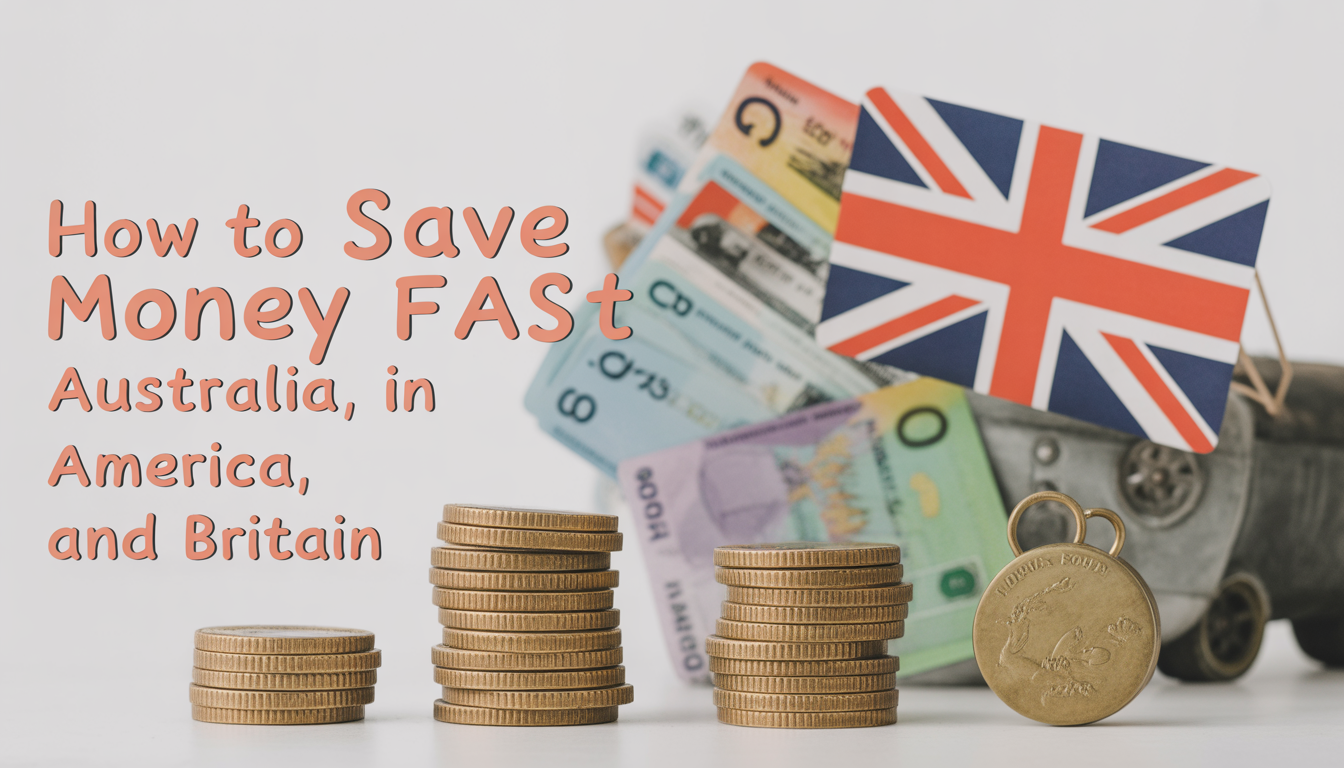
How to Save Money Fast in Australia, America, and Britain
(Because your wallet deserves a vacation too — even if you don’t.)
Saving money sounds simple.
Spend less. Save more. Done.
But in real life? Your salary disappears faster than free pizza at an office meeting. One minute you get paid, the next minute your bank account looks like it survived a natural disaster.
Whether you live in Australia, the United States, or the United Kingdom, the cost of living has climbed higher than a cat stuck on a rooftop. Rent, groceries, fuel, subscriptions, coffee habits — everything adds up.
The good news?
You can save money fast without living like a monk or eating instant noodles forever.
This guide will walk you through practical, realistic, and slightly humorous ways to save money quickly across these three countries. No complicated financial jargon. No unrealistic millionaire advice.
Just smart money moves real people can actually follow.
Why Saving Money Fast Matters Today
Let’s be honest — saving money used to mean planning for retirement.
Now it means:
- Surviving rent increases
- Handling emergencies
- Avoiding credit card panic
- Sleeping peacefully at night
Across Australia, America, and Britain, households face similar financial pressures:
- Rising housing costs
- Inflation hitting groceries
- Energy bills behaving like gym bodybuilders — always growing
Saving fast gives you financial breathing room.
Think of savings as your personal financial superhero.
No cape required.
The Big Money Differences: Australia vs USA vs UK
Before we dive into saving tricks, let’s understand the money environments in each country.
| Category | Australia | USA | UK |
|---|---|---|---|
| Housing Cost | Very high in cities | Varies widely | High in major cities |
| Healthcare | Mostly public + private | Expensive insurance | NHS public system |
| Transportation | Car dependent | Car focused | Strong public transport |
| Food Prices | Expensive groceries | Moderate | Increasing rapidly |
| Average Savings Culture | Moderate | Mixed | Traditionally cautious |
Key takeaway:
Different countries, same problem — money disappears quickly.
Step 1: The 24-Hour Money Reset (Start Saving Immediately)
If you want to save money fast, don’t start next month.
Start today.
Here’s your emergency money reset plan.
1. Cancel Financial Zombies
Financial zombies are subscriptions that eat your money quietly.
Examples:
- Streaming services you forgot about
- Old gym memberships
- Apps charging monthly fees
- Premium trials that never ended
Open your bank statement and ask:
👉 “Do I actually use this?”
If the answer is no — cancel it.
Quick Savings Example
| Subscription | Monthly Cost | Yearly Waste |
|---|---|---|
| Streaming Platform | $15 | $180 |
| Fitness App | $12 | $144 |
| Music Subscription | $10 | $120 |
Three cancellations = $444 saved yearly.
That’s basically a mini holiday fund.
2. Freeze Spending for 7 Days
Yes, it sounds scary.
But a 7-day spending freeze works wonders.
Rules:
- Buy only essentials
- No takeaway food
- No online shopping
- No “just browsing” Amazon sessions
You’ll quickly learn the difference between needs and late-night shopping decisions.
Step 2: Master the “Fast Savings Formula”
Saving fast requires three actions:
- Reduce expenses
- Increase income
- Automate savings
Let’s break it down.
Reduce Expenses Without Feeling Miserable
You don’t need to stop enjoying life.
You just need smarter habits.
The 50-30-20 Adjustment
Traditional rule:
- 50% Needs
- 30% Wants
- 20% Savings
For fast savings, try:
👉 60-20-20 temporarily
- 60% Needs
- 20% Wants
- 20%+ Savings
Short-term discipline = long-term freedom.
Step 3: Housing Hacks (Your Biggest Money Saver)
Housing eats the largest part of income in all three countries.
Australia
Cities like Sydney and Melbourne can feel like rent competitions.
Money-saving ideas:
- Share housing temporarily
- Negotiate lease renewals
- Move slightly outside city centers
- Rent furnished rooms short-term
Pro Tip: Landlords often prefer reliable tenants over new ones — negotiation works.
United States
America offers flexibility if you know where to look.
Try:
- House hacking (rent spare room)
- Relocating to lower-cost suburbs
- Refinancing mortgages when rates drop
- Remote work relocation
Some Americans save thousands just by moving 20 minutes away from downtown.
United Kingdom
UK renters know the struggle.
Smart moves:
- Consider commuter towns
- Split council tax with housemates
- Compare energy tariffs yearly
- Use public transport instead of car ownership
Housing Savings Comparison
| Strategy | Australia | USA | UK |
|---|---|---|---|
| Roommate | Huge savings | Common | Very effective |
| Move suburbs | Strong impact | Very strong | Moderate |
| Negotiation | Possible | Rare | Increasing |
Step 4: Food Spending — The Silent Wallet Killer
Food spending doesn’t feel expensive…
until you add it up.
That daily coffee?
It’s not a drink.
It’s a subscription disguised as happiness.
The Smart Grocery Method
Follow the 3-List System:
- Essentials
- Weekly meals
- Snacks (controlled chaos)
Never shop hungry.
Hungry shopping turns you into a financial criminal against your own bank account.
Grocery Saving Tricks by Country
Australia
- Buy store brands at Coles/Woolworths
- Shop evening discounts
- Use loyalty rewards
USA
- Coupon apps
- Bulk buying at warehouse stores
- Cashback programs
UK
- Aldi and Lidl shopping strategy
- Yellow sticker discounts
- Meal planning reduces waste
Food Savings Table
| Habit Change | Monthly Savings |
|---|---|
| Cooking at home | $200–$400 |
| Reducing takeaway | $150 |
| Bulk shopping | $100 |
Total potential savings: $450+ monthly.
That’s serious money.
Step 5: Transportation — Drive Less, Save More
Cars are expensive roommates.
They eat fuel, insurance, repairs, parking fees, and your patience.
Australia & USA
Car culture dominates.
Savings ideas:
- Carpool
- Combine errands
- Work from home when possible
- Compare insurance annually
United Kingdom
Public transport wins here.
Try:
- Railcards
- Monthly passes
- Cycling for short trips
Transportation Cost Comparison
| Method | Monthly Cost |
|---|---|
| Car ownership | High |
| Public transport | Medium |
| Cycling/Walking | Very Low |
Bonus: walking saves money and improves health.
Your doctor approves.
Step 6: Energy Bills — The Hidden Budget Monster
Energy prices have shocked households globally.
Quick fixes work surprisingly well.
Instant Energy Savings
- Turn appliances off at wall
- Wash clothes cold
- Shorter showers
- LED bulbs only
- Smart thermostats
Energy Savings Potential
| Change | Yearly Savings |
|---|---|
| LED lights | $100 |
| Lower heating 1°C | $150 |
| Efficient appliances | $200 |
Your future self will thank you every winter.
Step 7: The Income Boost Strategy (Fastest Way to Save)
Here’s a truth nobody talks about:
👉 Cutting expenses has limits.
👉 Increasing income doesn’t.
You can only cancel so many coffees.
But you can earn more.
Side Hustles That Work in All Three Countries
Popular fast-income ideas:
- Freelancing online
- Selling unused items
- Tutoring
- Delivery driving
- Pet sitting
- Remote digital work
Quick Side Hustle Comparison
| Hustle | Setup Time | Income Speed |
|---|---|---|
| Freelance writing | Medium | Fast |
| Selling items | Low | Immediate |
| Online tutoring | Medium | Stable |
| Delivery apps | Fast | Instant |
Declutter your house — you might literally be sitting on money.
Step 8: The Automatic Savings Trick
Humans are bad at discipline.
Automation saves us from ourselves.
Set automatic transfers:
- Salary arrives
- Savings move instantly
- You never see the money
- You never spend it
Magic.
Best Automation Method
- Open separate savings account
- Auto-transfer payday savings
- Increase percentage gradually
Even 10% automatic saving changes everything.
Step 9: Smart Banking and Interest Strategies
Different countries offer different opportunities.
Australia
- High-interest savings accounts
- Offset mortgage accounts
- Superannuation contributions
USA
- High-yield online savings
- 401(k) employer matches
- Cashback credit cards (used responsibly)
UK
- ISA accounts (tax-free savings)
- Regular saver accounts
- Premium Bonds
Savings Account Comparison
| Country | Best Tool |
|---|---|
| Australia | Offset accounts |
| USA | High-yield savings |
| UK | ISA savings |
Choosing the right account is like choosing the right tool — small difference, big results.
Step 10: Psychological Tricks That Make Saving Easy
Money success is mostly mental.
Here are powerful psychology hacks.
Rename Your Savings Account
Instead of “Savings,” try:
- Dream Vacation
- Freedom Fund
- Emergency Shield
- Future Me Fund
Your brain works better with purpose.
Use Cash for Fun Spending
Digital payments feel invisible.
Cash makes spending real.
When the wallet empties, spending stops automatically.
No willpower required.
Delay Purchases by 48 Hours
Want something online?
Wait two days.
You’ll realize:
You didn’t need it.
Amazon survives without your impulse buy.
Step 11: Country-Specific Fast Saving Plans
Australia: 30-Day Fast Save Plan
- Cancel subscriptions
- Reduce takeaway meals
- Switch energy provider
- Sell unused electronics
- Increase super contributions
Potential savings: AUD 1,000+ monthly
USA: 30-Day Fast Save Plan
- Refinance insurance
- Reduce car use
- Start side hustle
- Use cashback rewards
- Meal prep weekly
Potential savings: USD 1,200+ monthly
UK: 30-Day Fast Save Plan
- Switch utility suppliers
- Use ISA accounts
- Grocery discount shopping
- Reduce subscription services
- Public transport over car
Potential savings: GBP 700+ monthly
Step 12: Common Money Mistakes (Everyone Makes Them)
Let’s expose the usual suspects.
❌ Lifestyle Inflation
Income increases → spending increases.
Bad idea.
❌ Minimum Credit Payments
Interest grows quietly like weeds.
❌ Emotional Spending
Stress shopping feels good… until bills arrive.
❌ No Budget Tracking
If you don’t track money, money disappears.
Step 13: The 90-Day Wealth Jump Challenge
Want fast results?
Try this challenge:
Month 1 — Awareness
- Track every expense
- Cancel unnecessary spending
Month 2 — Optimization
- Negotiate bills
- Reduce housing & transport costs
Month 3 — Acceleration
- Add side income
- Automate savings
Many people save 3–6 months of expenses within one year using this system.
Step 14: Realistic Example — Saving Money in Real Life
Meet Alex.
Alex lives in a major city.
Before changes:
- Eats takeaway daily
- Multiple subscriptions
- Drives everywhere
After 3 months:
| Change | Savings |
|---|---|
| Cooking at home | $300 |
| Subscription cuts | $80 |
| Side hustle | $400 |
| Transport changes | $150 |
Total monthly improvement: $930
Not magic. Just decisions.
Step 15: How Long Until You See Results?
Good news:
- Week 1 → You notice extra cash
- Month 1 → Savings grow
- Month 3 → Stress decreases
- Year 1 → Financial confidence skyrockets
Saving money fast isn’t about perfection.
It’s about momentum.
Final Thoughts: Saving Money Is Freedom, Not Punishment
Here’s the truth nobody says loudly enough:
Saving money does not mean living a boring life.
It means:
- Less stress
- More choices
- Better sleep
- Freedom from paycheck panic
Whether you’re in Australia, America, or Britain, the rules are surprisingly similar:
✔ Spend intentionally
✔ Earn creatively
✔ Automate consistently
✔ Stay patient





Leave a Reply